Replace The Gym With Your Body
To develop a powerful and aesthetic physique, many fitness enthusiasts believe you need to routinely lift heavy weights. Building large, strong muscles involves applying sufficient resistance to induce microcellular damage, which your body repairs during rest and recovery.
Personally, I believed in this philosophy of physical fitness where only heavy weight lifting was the main strategy for building muscle. As long as I didn’t overtrain or lift beyond my maximum load, I felt I could continue training this way for years.
As time went on, I found that although I was making some progress each year, the gym was becoming increasingly inconvenient. For one, the gym wasn’t always accessible, whether I was traveling or the facilities were shut down due to government safety protocols.
Gym memberships are also very costly to maintain annually and cut into funds that could be spent elsewhere, building your own home gym (see How to Design A Workspace For Your Home Gym). A gym area in your home saves you money and time spent commuting to and from your workplace.
Another factor to consider is the long-term wear and tear on the joints from lifting heavy weights. To see significant muscle growth, one would need to apply progressive overload consistently by increasing reps, sets, or weight over time.
Compared to dynamic calisthenics training, linear weight training only builds strength in the gym and limits the strength required for functional movements (such as carrying loads, climbing vertical surfaces, and rotational upper-body movements).
I’ve always been a big proponent of exercising on the go (see What Kind Of Workouts Are Needed While Traveling and The Best Calisthenics Exercises For Working Out While Traveling), which was especially convenient when access to a gym with sufficient equipment wasn’t an option.
Regardless, most people introduced to bodybuilding will be encouraged to train in a big-box gym, as a structured environment is more comfortable than learning on your own. The exercises that can only be performed with barbells and dumbbells can be replicated if you don’t have access to a gym.
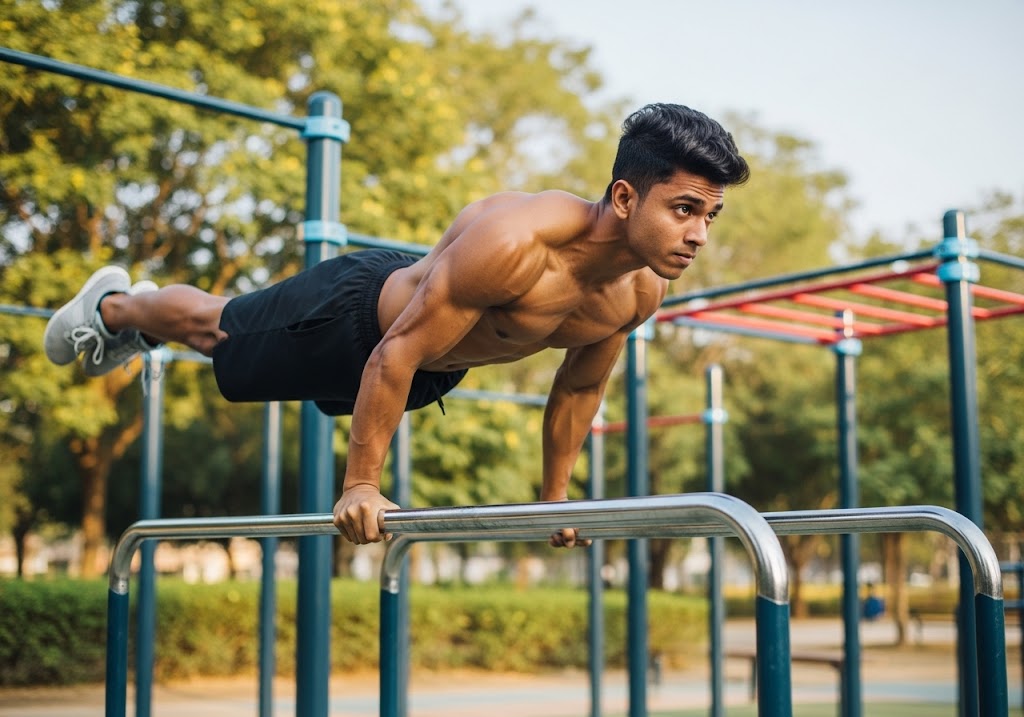
Bodyweight Exercises That Could Replace The Big Lifts
The common theme with most workout programs is body splits (such as Push/Pull/Legs or Back/Biceps, Chest/Triceps/Shoulders, Legs/Abdominals) that target the muscles at least 2x a week for maximum growth. Large muscle groups usually have a wide variety of exercises that can be performed and vary depending on the weight lifter’s level of experience.
Bodyweight exercises can be performed with compound movements that train multiple muscle groups and are just as effective for promoting growth. I’ve selected these six main movements that can be routinely performed on a weekly basis for great results outside the gym:
Back Exercises
Pull-ups (in place for Lat Pulldowns)
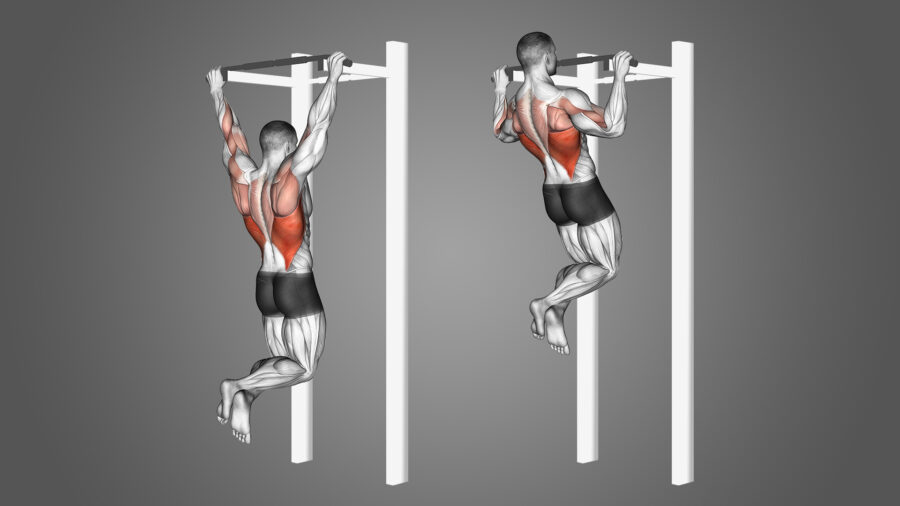
Pull-ups are the best movement for developing the back’s width and growing the shoulders and trapezius muscles. Pulling exercises are even more challenging because they involve negatives (eccentric movement) that require more control of your body weight and power to pull the body to the top of the bar.
The traditional range of motion for pull-ups is to start on the bar from a dead hang, with both arms extended wider than shoulder distance, and pull the body up until your chin is at the top of the bar. Lowering your body back to the dead hang starting position completes the full repetition of the movement.
While this will help your body complete the exercise and become stronger, it is not the best way to develop the large back muscles (latissimus dorsi) to give you a wider look. This is because the tension from the exercises shifts from the lats to the upper back/shoulders, shifting the resistance to the other muscle groups.
To develop the back muscles to their fullest extent, keep the muscles under tension by maintaining a shorter range of motion: stop the lowering of your body mid-way, with the elbows bent, and pull your body up to eye level with the bar.
Using pull-ups can serve as a substitute for lat pull-downs and can be progressed by wearing a weight vest or belt with suspended plates. Slowing the tempo of the concentric and eccentric portions of the movement is how you advance further to build more strength.
Inverted Rows (in place for Bent Over Dumbbell/Barbell Rows)
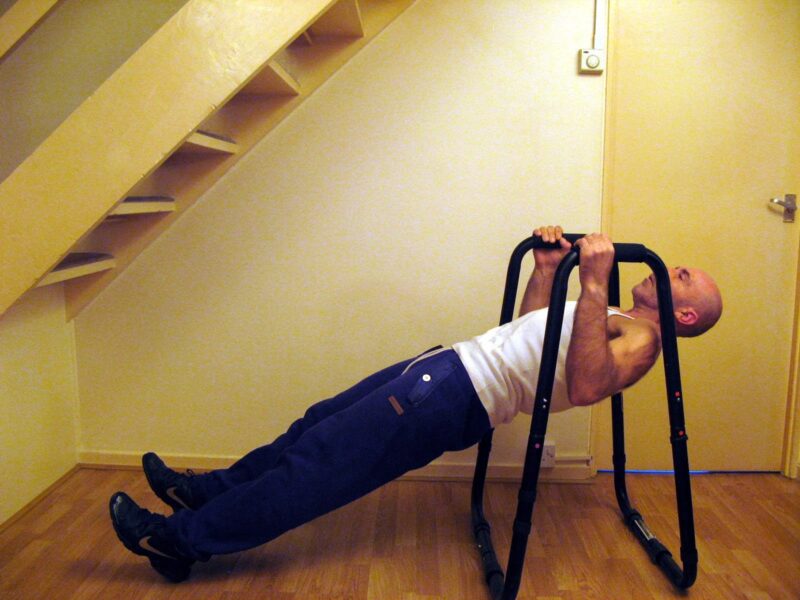
The inverted row allows you to develop the thickness of the back without putting strain on your spine by extending your spine while performing the bent-over row. Inverted rows target the same rhomboids, latissimus dorsi, and trapezius muscles of the upper back as other rowing movements.
Start by holding on to an object (suspension straps, a towel hung between a door frame, dip bars, or a table) at waist level, and place both hands shoulder-width apart. Your body should be extended in a straight line from head to heels as you pull your chest up to the bar/both hands are brought closer to your chest.
Moving the bar/straps closer to the ground will make this exercise more challenging, along with elevating both feet off the ground. Again, adding a weighted vest will increase resistance, along with holds at the top of the movement for 1-2 seconds. Repetition ranges should be 8-12 for 3 total sets.
Chest Exercises
Push-ups (in place for Bench/Dumbbell Press, Dumbbell Flys/Pec Dec Flys, Pullovers, Cable Crossovers)
The push-up is a basic calisthenics movement that should be part of any training routine, whether strictly training with weights or not. The wide range of hand and leg placements during push-ups makes this exercise great for beginners and advanced lifters alike.
The movement starts in a plank, with the body extended from head to heel, supported by both arms at chest level. For those who need more support, you can bend the knees while keeping the arms extended to support your body weight. Begin lowering the body until the chest is parallel to and touching the floor. Push up from the floor using your arms to complete the repetition at the top of the movement.
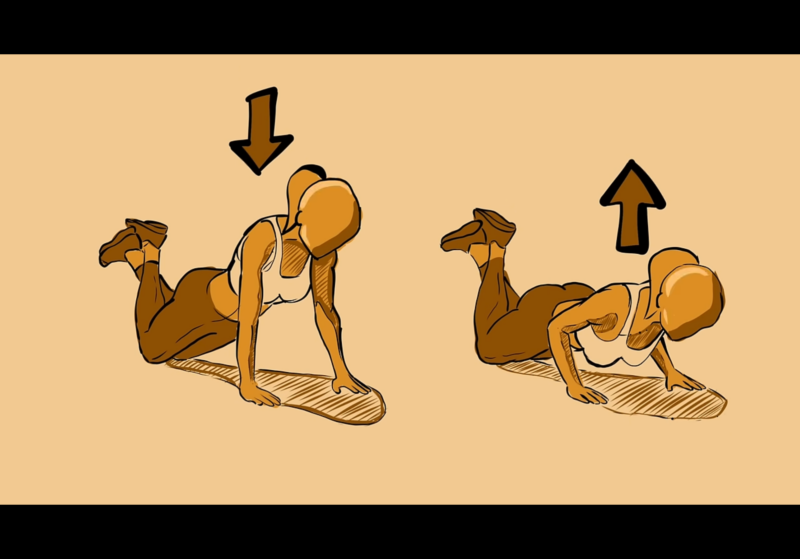
As with the pull-up, the key to maintaining tension on the target muscle (the chest) is to limit the range of motion during the exercise. The traditional push-up will build strength with good form, but when done this way, the tension of the exercise shifts to other muscle groups. To make the chest really grow, perform small ranges of motion by preventing the arms from fully locking out at the top of the movement and preventing the chest from touching the ground when lowering your body.
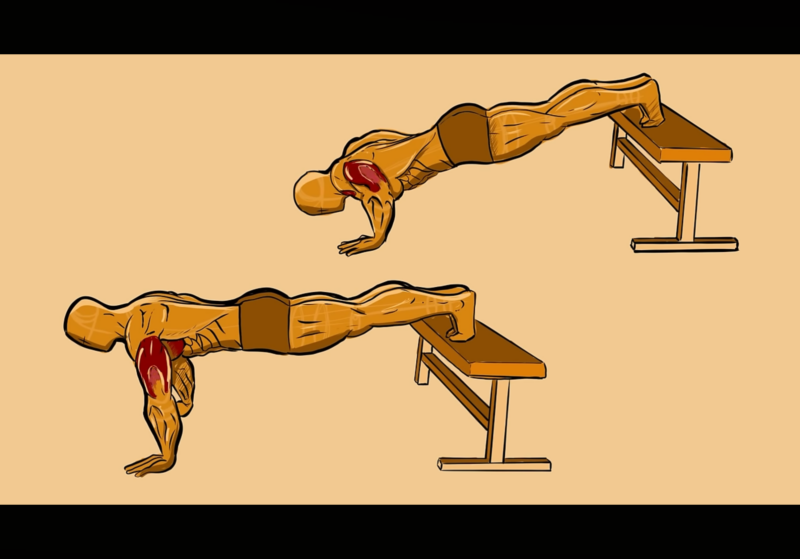
The push-up can become less challenging as you build strength, allowing you to complete a couple of dozen repetitions with good form, which is why you need to add variations. Elevating the feet 8-12” from the ground changes the target of the chest muscles to emphasize more of the front and rear deltoid muscles in the shoulder. It also increases the total percentage of body weight moved with each repetition compared to the standard push-up.
Advanced movements involve increasing the width of the hands (wide grip push-up), decreasing the width to the center of the chest (diamond push-ups), removing one arm (one hand push-ups), supination of the wrists (reverse grip push-ups), and resting only on the fingertips to concentrate on the wrist flexor muscles (finger tip push-ups).
Changing the angle of the feet/hands also extends the movement. Place the hands on an elevated surface, then lower the body until both elbows reach 90 degrees (Incline Push-ups). Handstand push-ups involve raising both feet in the air while balancing your weight on your extended arms for repetitions. To build balance, practice wall push-ups until you have enough strength for a complete handstand.
There are over 20 variations to the standard push-up that can be used.
Chest Dips (in place of Close Grip/Decline Bench/Dumbbell Press)
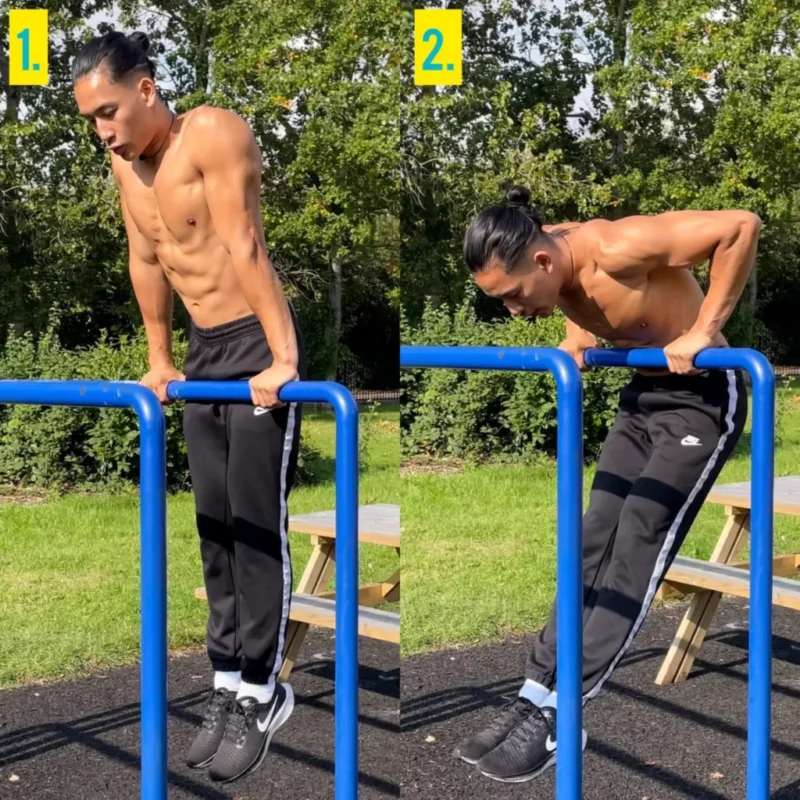
Chest dips are able to target the triceps muscle in the arm as well as many of the other presses you will see on the bench. When performed properly, they can develop the lower pectoral muscles as well as the long head of the triceps, which makes up a large portion of girth within the arm (see How to Get Super Defined Arms).
On a set of bars, grip the bars with both hands and slightly bend your body forward to put more of an emphasis on the chest. With both arms fully extended, begin to lower your body towards the ground until your upper arms are parallel with the ground. Push your body up until your arms are fully extended for a complete repetition.
Dips train your chest by engaging more muscle groups, just as squats target the legs. Almost all of the muscles in the upper body are involved and require complete control of your body weight to perform each repetition.
If you’re not strong enough to perform bar dips, you can modify them by doing bench dips with both feet fully extended in front of you. With your hands gripping the edge of the bench, lower your body towards the ground until both elbows are bent at 90 degrees, then press back up. Aim for 15-20 repetitions using the bench dips, then progress to bar dips.
Leg Exercises
Bulgarian Split Squats (in place of Front/Back Barbell Squats)
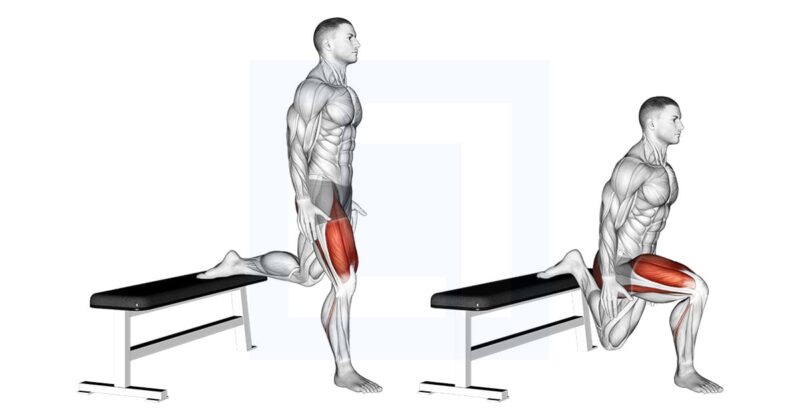
The Bulgarian Split Squat targets the glutes and quadriceps more than a traditional barbell squat. This is because single-leg movements elicit a stronger stress response than bilateral exercises, with less joint stress during the exercise.
Start by standing two feet in front of a bench, with one foot elevated and the shoelaces lying on the bench. Lower your elevated knee until it touches the floor, then, using your front leg, stand back up. The exercise is challenging with just bodyweight, but can be progressed with a weighted vest or dumbbells in both hands. Target rep range for each leg should be 8-12, with 3 sets.
Single Leg Romanian Deadlift (in place of Front/Hack/Back Barbell Squats/Barbell Deadlift)
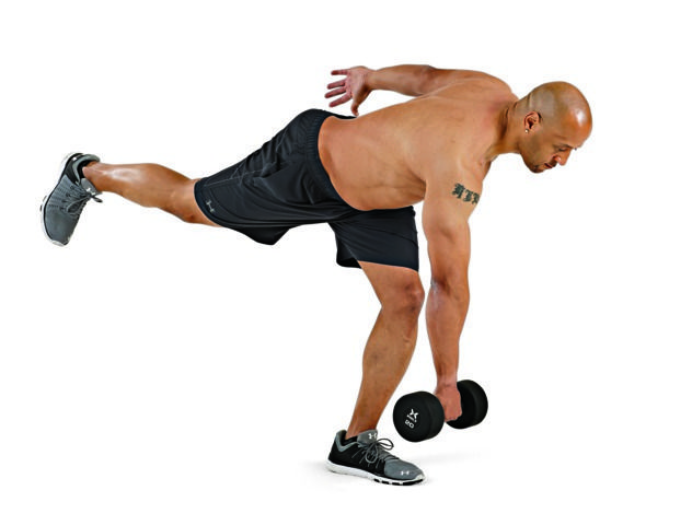
When you isolate the legs individually while training, you expose the strength imbalances and areas that need improvement. Single Leg Deadlifts accomplishes this by strengthening the posterior chain muscles, as well as the hamstrings and glutes without compressing spinal discs in the spine.
The hinge at the hips is strengthened to improve performance when lunging, sprinting, and maintaining an upright posture while standing. The exercise also stimulates your core muscles without adding extra weight, reducing the risk of injury from heavier loads.
Start the exercise on one foot with a slight bend at the knee and a dumbbell weight in the other hand. Hinge at the hips and let the weight travel down the side of your leg as your trailing leg lifts to counterbalance. Continue raising your trailing leg until you feel a stretch in your hamstring, then drive your hip forward to stand back up.
This exercise is somewhat challenging when you first try it, and you will find you need to perform it unassisted, without weight. Learn the movement pattern first by performing 8-10 repetitions for 3-4 sets, then progress to a dumbbell when you can perform 10 repetitions per set.
The Wrap Up
It’s possible to build a decent physique outside of the gym, in spite of the dogma that heavy barbells and dumbbells are required to accomplish this. Although progressive overload is a necessary principle in bodybuilding, bodyweight exercises can provide sufficient resistance to stimulate muscle growth over time. Our muscles don’t care what weights we’re lifting, as long as they’re getting stimulated and challenged, this is where growth is triggered.