Getting Depressed From Your Weight Scale
Jumping on the scale can the most nerve wracking part of the week if you’re trying to gain or lose weight. Everything that you’ve done right or wrong is gonna boil down to that one number that you’ve been hoping would move the way that you wanted to.
…and then all of sudden when you look down there’s the number that you didn’t want and it’s way worse than you thought it was going to be.
I think part of the reason why people jump from diet to diet and try new fads that sound good at first is all because of the weight scale.
While your weight is important to a degree, it really should only be ONE indicator of whether you’re physique is headed in the right direction. Read more to find out why.
Why The Weight Scale Is Somewhat Overrated
There are many subtle factors that can throw off the true measurement of anything that can get placed on a weight scale (see How to Weigh Yourself Properly). The fact that you’re never really getting a 100% accurate measurement of yourself at any given time is enough to not rely on that alone for tracking.
The second reason is that weight is distributed according to the ratio of lean body mass to fatty tissue. Your weight can drop as you’re losing the wrong type of tissue, due to a host of factors you’re supposed to be monitoring simultaneously (more on this later).
An example of this is when someone tells you their weight, and visually, their body shows something else. Have you ever wondered why someone else at 200lbs can look completely different than someone else at the same weight?
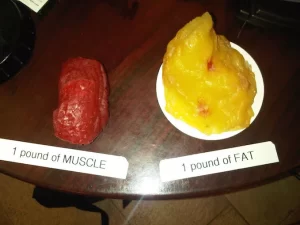
The reason is the difference in weight and density between muscle cells and fat cells. A liter of fat weighs 1.98 lbs, and a liter of muscle weighs 2.3 lbs.
Fat also has a density of 0.9g/mL, while muscle has a density of 1.1g/mL. That’s why the same weight can look hugely different in two different people:
That’s also a reason why losing weight rapidly can indicate that you’re more likely to be losing muscle mass than fat. Muscle weighs a bit more, so losing weight quickly is never a good thing.
For this reason, crash diets get quick results now and horrible results later down the road. Weight distribution gets thrown off. A good example of laugh now, cry later.
The Wrap Up
Weighing yourself isn’t something you should avoid, but it definitely shouldn’t be the only indicator of what progress should be. Physiologically, many things are happening to your body at once when you’re exercising, so you can’t pinpoint everything you’re doing right to just one number. Use the scale number in conjunction with tape measurements of your body parts to get an idea of what you need to do next.
What else do you want to know?
How to Properly Weight Yourself
How to Accurately Measure Your Body Fat Levels
How to Take Your Body Measurements